
New documents reveal years of ‘stealth destaffing’ at Southeastern, as its network is exposed to be severely understaffed, with ticket offices meeting their scheduled hours at an average of just 74% for the last two years. It has now begun a secretive new ‘Ticket Office Project’, involving the removal of afternoon shifts, and piloting of new job roles at 14 Kent stations.
Our freedom of information requests to Southeastern show that 14 stations are due to have their ticket office opening hours cut by half: a daily loss of 6-7 hours staffing hours, for 5-7 days per week.
The stations due to lose their afternoon shifts are: Beckenham Jn*, Bexleyheath*, Hayes (Kent), Mottingham*, New Cross*, New Eltham*, Petts Wood*, Welling* (Metro area stations); and Battle, Bearsted, Deal, Otford*, Wadhurst, West Malling (located across Kent). *The nine starred stations are served by driver-only trains.
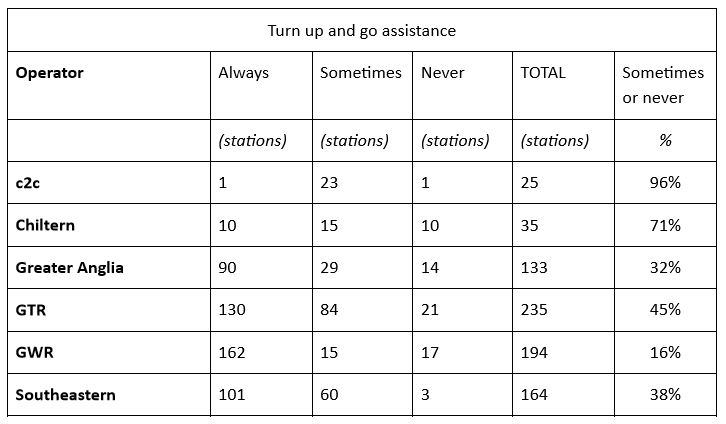
When the afternoon shifts are removed, passengers will be unable to access retail advice, or the full range of affordable tickets. If staff are completely removed from the stations, toilets and waiting rooms will be made unavailable, and where stations are served by driver-only trains, boarding and alighting assistance can’t be provided – preventing disabled people’s right to ‘turn up and go’.
David Wornham, Southeastern’s Passenger Services Director said:
“Recently, changes were made at Otford and Deal, which both typically see no more than 10 ticket sales per hour each shift. We plan to adjust hours at another 12 ticket offices in 2025. Stations will remain staffed, with accessibility and safeguarding assistance provided by platform staff.”
Southeastern is making the changes without consultation
Despite the slashing of around 50% of ticket office staffing hours at the 14 stations, the changes did not go through any sort of public consultation and have been kept secret until now. This is because they were originally approved by the DfT in January 2022, when Southeastern used the ‘Minor Change Process’ of Schedule 17 of the Ticketing and Settlement agreement to notify of the changes. It is only now that Southeastern has begun the process of permanently removing the shifts.
Of the list of 14 stations, just Deal and Otford have lost their afternoon ticket office shifts so far; and Southeastern plans to cut afternoon shifts at the remaining 12 early next year. This is all being done against a background of long-term ticket office under-staffing across the whole Southeastern network, averaging just 74.31% for the last 26 months.
Southeastern said: “Following a national consultation confirming that no ticket offices will close we are recruiting and training around 100 additional ticket office staff this year. To date we have recruited 97 of these and this will lead to significantly increased ticket office hours.”
A long-term strategy of stealth destaffing
The new documents suggest that Southeastern had been conducting a long-term strategy to shed ticket office staff. In an Equality Impact Assessment (EqIA) from October 2024, Southeastern states:
‘In 2022 [redacted] went through the ticketing settlement agreement minor change process to remove the requirement for an afternoon shift at these locations. At the same time staffing was reduced through a voluntary severance scheme to leaving [sic] enough staff remaining only for a morning shift. Customer-facing information was not changed at this time. The objective is to confirm the future staffing makeup of [redacted] align the customer facing information with the ticket office staffing times.’ (EqIA, page 8)
Though heavily redacted, the document shows that Southeastern’s current Ticket Office Project is part of a “change programme”, which appears to relate to a new staffing strategy “…which will focus on less shift work and more fixed shifts”. “The majority of positions that would be affected by this change are currently vacant” and there is “increased working outside” as part of a “change [that] will help our people start to think differently about their roles and prioritise the customer service they are brilliant at giving rather than primarily being an underused sales point.”
No Equality Impact Assessments for the Schedule 17 changes
We have confirmed that no EqiAs were completed for these changes when they were approved by the Department for Transport in 2022. However, Southeastern provided us with a draft EqIA (Oct 2024) for the removal of the afternoon shift that recently took place at Deal and Otford stations. The heavily redacted document shows little evidence that the impact on passengers, especially disabled people, has been considered.
According to Southeastern: “we currently only have the EqIA for Otford and Deal approved. EqIAs for the other locations will be approved before formal changes are made…These changes, which are supported by an Equalities Impact Assessment, were approved under the previous government. Future changes will need to be approved by the current government.”
We asked the Department for Transport 1) whether they had approved Southeastern’s current ‘Ticket Office Project’; 2) whether other operators were conducting similar stealth destaffing programmes; 3) and whether they intended to take action on Southeastern’s 74% average compliance with ticket office staffing obligations.
The DfT responded: “We recognise the vital role ticket offices play in the journeys of people with disabilities, and we have no plans to close them. These ticket office changes were agreed under the previous Government. The Department is now examining Southeastern’s plans to ensure passengers remain supported.”
Future dangers of ticket office closures and stealth destaffing
Southeastern’s actions prove the ongoing dangers of Schedule 17 of the Ticketing and Settlement agreement (TSA) – re the ways it can enable train operators to destaff their networks by stealth. In this example, Southeastern was able to play the system to cut around 6-7 hours per day of ticket office staffing without consultation by calling it a ‘minor change.’
Schedule 17 is an out-of-date and inadequate process, allowing train operators to close ticket offices based on sales figures alone, without taking account of other passenger needs, especially accessibility. The TSA is technically an agreement between operators and the unregulated Rail Delivery Group, and the fact that Southeastern’s compliance figures have been running at 74% for so long suggests it is not being enforced. The Schedule 17 process has clearly been facilitating a vicious cycle of managed decline, where operators can secretly make drastic changes to opening hours, based on sales figures from ticket offices that are not complying with their opening hours in the first place.
Most concerning of all is that the TSA is the only way that any staff hours are regulated – ie, in this case we only have Southeastern’s figures for ticket office staffing, with no way of obtaining the figures for station staff, etc; which are essential to assessing the true scale of the cuts.
These warnings about Schedule 17 and stealth destaffing were also the subject of our 2023 campaign letter against ticket office closures, which spells out the dangers in more detail.
The government must take responsibility
The Department for Transport must act immediately to stop the secret programme of ticket office cuts at Southeastern. It must then take responsibility for staffing strategy across the entire railway, beginning with the immediate enforcement of Schedule 17 hours, and ensuring compliance figures are published regularly by all operators.
We also need to see new, nationwide standards for staffing, ensuring there is always a member of staff available to provide safety, security, information, retail services and assistance – also an absolute necessity for disabled people’s right to ‘turn up and go’. Regulatory measures should be updated to include transparent reporting of staff figures of all types, with a requirement to publicly consult on all changes to retail, staffing and accessibility.
For the full set of documents from our Southeastern investigation, download zip folder here.
For more information: contact@abcommuters.com
*Note: this blog was edited shortly after publication to include the Department for Transport’s comment.










 abcommuters.com