At a time when rail francising is clearly collapsing, today’s 2.7% fare rise is an outrage. It’s another sign that the government and industry will continue to treat us like a captive market, meaning that we’re continually paying more while constantly receiving less. Today, we’ll be joining with passengers around the country to demand a nationwide fares freeze, in recognition of the fact that UK public transport is now at the point of social, economic, and environmental crisis.
Protests begin at London Kings Cross at 8am and you can view the full schedule here.
A National Crisis in Public Transport
For the last ten years, rail fares have been rising at twice the speed of wages. For many commuters on a lower income, this is more than just a matter of yearly injustice – they are being priced off the railway altogether.
And for bus passengers, things are even worse. Bus fares are rising at an even higher rate than rail, according to government statistics published last month – a shocking 3.3%. Unlike rail fares, bus fares outside of London are completely unregulated, meaning that bus companies can put up fares as and when they choose and do not even have to give a warning to passengers. Alongside the withdrawal of local investment and routes, this is pricing thousands of people out of bus travel, if they even have a service left at all.
Transport is the UK’s biggest polluting sector and the modal shift from car to public transport is a matter of urgency; not just for climate change but for public health, social equality and regional development.
No faith in the Williams Rail Review
The Williams Review was launched by the government soon after the timetable collapse of 2018, promising a ‘rail revolution’ and an end to the failed and fragmented franchising system. The government used this promise to evade a response to their leading role in the catastrophe; meaning that – to this day – they have not answered for the 2018 timetable crisis.
The reality of the Rail Review was nowhere near the ‘rail revolution’ promised. It had a narrow, ideological remit that excluded public ownership from the very start, and was also required to be ‘fiscally neutral’. The Rail Review that had begun by promising to ‘scrap franchising’ gradually lost all credibility as the government continued to award franchises regardless – East Midlands Trains and the West Coast Partnership.
Since the launch of the review in September 2018, Keith Williams has failed to report back. It is therefore without any public scrutiny that he approved the West Coast Partnership award to FirstGroup as ‘Williams compliant’ back in August. First Group shareholders, meanwhile, have been assured in the financial press that their future in UK rail looks more lucrative, thanks to an arrangement that protects the company from risk. The Financial Times has said that this is ‘the first time in ten years that a rail company has had financial protection.’
In a further twist to the tale, the government is being taken to court early this year over the by three different train companies over its franchising practices: Stagecoach, Virgin and Arriva. If it doesn’t go the government’s way, the cost to the taxpayer could be tens of millions – so how can we possibly trust the government to make further changes to the franchising system in the meantime?
Finally, we are extremely concerned about the excessive influence of the rail industry lobby on the outcome of the rail review. The Rail Delivery Group is calling for a mix of management contracts, concession-style models, and competitive intercity franchising, along with the proposal of an organising body resembling the ‘Strategic Rail Authority’ that was abolished in 2006. With franchising failing, it stands to reason that private train companies will be seeking to keep franchising alive, and the example of the West Coast Partnership already does not bode well for the promised ‘rail revolution’.
Passengers and taxpayers are being denied a proper, democratic conversation about the future of our public transport system, which, in the era of Brexit, is now at the point of a national emergency if we are to build the equitable country we want to see now, and in the future.
It is now Day Nine of the longest-running rail strike in UK history and South Western Railway passengers have been abandoned by the government. The guards dispute has been going on for almost four years across multiple UK rail franchises, and yet we are no closer to seeing a resolution. In fact, the situation is getting even worse, with passengers on SWR being expected to pay for the latest strike out of their own pockets.
If South Western Railway gets compensation for the strikes – why can’t passengers?
Season ticket holders are currently being denied compensation by SWR, despite the fact that its majority owner FirstGroup has been in negotiations with the Department for Transport for ‘strike amelioration’ compensation all year. Last week, the government again refused to clarify this amount, but the RMT union claims that SWR could be receiving as much as £86 million in strike compensation to date.
Any compensation for lost revenue paid to SWR by the government would be part of an agreement where industrial action is considered ‘outside of the train company’s control’ (force majeure):
From page 524 of the SWR franchise agreement, available to view here.
Any such arrangement would mean that SWR has been disincentivised to end the dispute and that the government is using taxpayers’ money to fund it. It would also suggest that passenger compensation has been treated as an afterthought by both rail industry and government- implying that nine days into the strike, they have not bothered to factor it into their negotiations.
The following tweets prove that SWR is sending mixed messages on compensation – even to the point of giving passengers false hope, and then retracting it a few days later:
Season ticket holders fight back!
Govia Thameslink Railway season ticket holders received a month’s compensation for industrial action in 2016, and again after GTR caused a major timetable crisis in 2018. There’s also a precedent on Northern, where season ticket holders were invited to claim compensation proportional to the daily price of their ticket during industrial action.
We urge SWR passengers not to accept the following excuse given out by the train company and would seriously question the validity of SWR’s advice on this issue:
Demand compensation under the Consumer Rights Act
Passengers are self-organising, with mass compensation claims to South Western Railway citing the Consumer Rights Act. There’s a template letter for season ticket holders here, and claims should be sent to customerrelations@swrailway.com. (Credit to @HSLcommuter for the template letter.)
If you bought your season ticket on a credit card, it is worth attempting to claim back a proportion of your season ticket using Section 75. Back in 2017, one of our members succeeded in doing this, and got a £2,400 refund on his season ticket through his Amex card. To find out more, check out Parts One,Two and Three of our guide, which is based on the method he used. The advice relates to Southern Rail, but the templates can be adapted to any train company.
If you’ve encountered additional expenses, such as taxis or hotel costs, be sure to make a claim to SWR under ‘consequential losses’. A Telegraph article from last week confirms that SWR will be considering these – despite the fact that the rail industry has been shown to be highly resistant to the idea of reimbursing passengers for their expenses in the past. Last year, it took an intervention from the consumer rights charity Which? to force the rail industry to include ‘consequential losses’ in the National Conditions of Carriage.
We hope to hear of many new consumer rights precedents being set in this area – please share your success stories via contact@abcommuters.com
**Good luck to all passengers and please note the following disclaimer:
All sample letters provided by ABC are templates only. Any person using them does so at their own risk and is responsible for the content and the accuracy of the claim. ABC is not a party to any claim made in accordance with these guide or otherwise, and accepts no responsibility or liability for the content and/or the accuracy of any information included in any such claim. ABC does not guarantee the outcome of any claim and accepts no liability whatsoever in the event of a claim being unsuccessful.
In a major victory for our campaign, the government has just been forced to release the controversial Steer report on driver only operation (DOO) and disabled access. We had been pursuing this report through freedom of information requests to the Department for Transport since the summer, but without success. However, a copy was sent to Lilian Greenwood last month and – in one of her final acts as Chair of the Transport Select Committee – she has now published it on the Committee’s website.
With this decisive action, Lilian has ensured that the Steer report has been revealed before the general election ‘purdah’ period kicks in, which is a victory for campaigners – and an unexpected embarrassment for both the government and the rail industry.
A ‘wholly inadequate’ report – approach with ‘extreme caution’
We knew that the content of the Steer report would be controversial because of this damning letter from the Disabled Person’s Transport Committee (DPTAC), the DfT’s statutory advisors on accessibility. The letter urges ministers to approach the report with ‘extreme caution’, warning that it is ‘wholly inadequate’ in providing mitigations for the ‘toxic combination’ of driver only trains and unstaffed stations. Both the DPTAC letter and an accompanying email question whether the DfT and train operating companies are meeting their legal duties under the Equality Act.
As documents from DPTAC demonstrate, there is an ‘urgent and unmet need for research’ relating to disabled access, staffing levels and modes of operation. And it’s been three years since the Transport Select Committee first requested an equality impact assessment on the issue. The unacceptable delay to research in this area is in our view due to two reasons: 1) the absence of staff cannot be mitigated by any other means except staff – therefore it is logically impossible to create a report showing that DOO can be introduced without regressing disabled access by normalising pre-booking instead of asserting the right to spontaneous travel. 2) The fragmented industry structure and constrained contractual relationships create a toxic mix where research and policy is developed not in the public interest, but dominated by train operating companies (via the Rail Delivery Group) in the interests of profit.
The Steer report is supposed to give clear guidance on the mitigations required to assist and protect disabled passengers when there are no staff on the train or station. However, it drastically fails to meet that objective, and in fact demonstrates that no mitigation is possible – and therefore that a full staffing model is the only solution. The report reads precisely as if it was strung together from a desired conclusion, and its release is undoubtedly highly embarrassing for its authors, the government and the rail industry.
The Equality and Human Rights Commission is now treating access to transport as a priority issue and has established a fund to support legal challenges. Equality law firm Fry Law has even been sending out cameras to assist disabled passengers in capturing evidence for the inevitable legal cases to come. In a situation where unstaffed trains are calling at unstaffed stations about 10% of the time (according to DPTAC’s estimate), it can only be a matter of time before we see new legal precedents set in this area.
The Disabled Persons Transport Advisory Committee (DPTAC) are statutory advisors to the Department for Transport on accessibility, making them the best possible source for an expert opinion with a front row seat on policy issues. We have previously published dozens of documents detailing their opposition to driver only operation and station destaffing; in which they cite their concerns about the potential Equality and Human Rights Committee legal action on this issue.
With this in mind, we believe that the Office of Rail and Road’s new ‘Accessible Travel Policy’ contains a regulatory hole around accessibility. Their new guidance to train companies aims to reduce the advance booking period from twenty-four to two hours by 2022, but includes no obligation to spontaneous ‘turn up and go’ travel. The ORR says that staffing issues are not part of its remit, but in view of their own duty under section 149 of the Equality Act, we asked them to comment. Unfortunately, they informed us that they would only be reconsidering this issue if government, the Williams Review or ‘other regulators’ took decisions in this policy area.
But, all is not lost. In the ORR’s July submission to the Williams Review, they place a strong emphasis on the need for a whole system approach to accessibility, based on clear criteria for both funding and staffing. And the ORR has made a very clear recommendation that this ‘whole system approach’ should be led by DPTAC.
Why are the DPTAC documents so important?
DPTAC’s May 2019 submission to the Williams Review provides exactly this outline of a ‘whole system’ approach. With the ORR’s backing, it is now undoubtedly the most important document on accessibility in the entire Williams Review:
DPTAC recommends a ‘paradigm shift’ in which accessibility becomes a ‘fundamental’ part of the industry, rather then just an ‘add on’. Their May submission to the Williams Review includes a damning analysis of rail industry culture and structure; and calls for a ‘whole system’ approach that embeds accessibility ‘into the heart of what the rail industry does’. DPTAC also argues that rail vehicle accessibility legislation (TSI/RVAR) has provided a ‘relatively strong baseline’, and that there is now a strong case for new regulation with compliance deadlines for station accessibility. This would form part of a long-term funding strategy that could see the timeline to ‘full accessibility’ reduce from 100 to 40 years.
DPTAC’s May submission to the Williams Review is an essential report for all transport and disability rights campaigners and we ask for your help to spread it widely. It is important to remember that the government has set Williams’s remit to be ‘fiscally neutral’ – so it will take a great deal of campaigning and/or legal actions to get these demands over the line.
The ONLY quantified overview of rail accessibility?
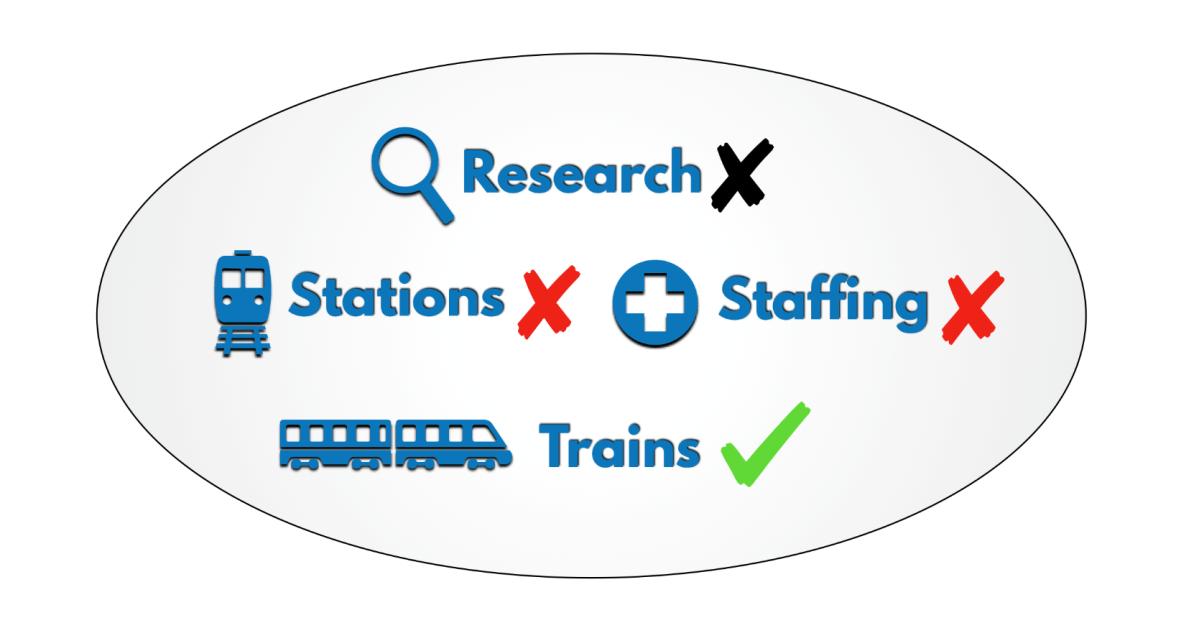
The biggest theme emerging from the latest DPTAC documents is the ‘urgent’ and ‘unmet’ need for research, and the ‘dearth of detailed data’ on staffing levels in particular. They make clear that the problem is endemic, with ‘no agreed approach to quantifying the accessibility of the rail network’ and in many areas ‘a lack of quantified data on specific aspects of network accessibility.’ The state of transparency around accessibility research remains a matter of serious concern to us, with the DfT still refusing to publish the ‘wholly inadequate’ Steer report on modes of train operation following our request for an internal review of their FOI decision.
The above statistics are taken from pages 2 to 3 of DPTAC’s submission to the Williams Review and are drawn almost entirely from the 2015 report ‘On Track for 2020’. This report is considered by DPTAC to be a ‘unique’ overview – and the most up-to-date source of quantified data on rail accessibility. And yet, this report was withheld until June 2017 by the Rail Delivery Group, when we published a copy and forced its official release.
Another important point to make is that the ORR will have gone forward with the publication of their new Accessible Travel Policy (ATP) based in part on the very same Steer research on ‘modes of train operation’ that DPTAC has stated is ‘wholly inadequate’ and should only be approached with ‘extreme caution’. Earlier this week, campaigner Doug Paulley succeeded in getting the ATP sent back to the ORR for a ‘rethink’ after threatening a judicial review over the accessibility of rail replacement buses – so is there scope to go further in other areas of the guidance too? We think it’s time to question whether the ORR is using the full extent of its regulatory powers – especially in regard to the changing landscape of railway staffing.
Other essential DPTAC documents:
DPTAC’s reponse to the DfT’s PAYG consultation goes into further detail about the need for a new staffing model at a time of technological change (April 2019): download here.
DPTAC’s initial submission to the Williams Rail Review goes into detail about the ‘urgent’ and ‘unmet’ need for research (January 2019): download here.
Read the full story of the Steer report controversy here.
Read DPTAC’s letter to Ministers about driver only operation and destaffing here.
Read DPTAC’s email chain containing urgent questions to Ministers concerning driver only operation and the Equality Act here.
Last week, it was revealed that the Rail Delivery Group failed to communicate changes to penalty fares legislation to train operating companies, leading to the overcharging of up to 10,000 passengers. The overcharging follows a similar scandal revealed in 2018, when the Rail Delivery Group failed to update changes to the Consumer Rights Act regarding ‘consequential losses’. On that occasion it took an intervention from Which? for the Rail Delivery Group to incorporate consumer rights legislation that had changed eighteen months earlier.
The Rail Delivery Group (Association of Train Operating Companies Ltd.) is now presiding over a major fares and ticketing restructure, and is by far the loudest voice in the Williams Rail review. So, it is up to passengers to get ahead of the game and call for real change, which can only start by addressing the train operating companies’ financial incentives. It is long past time to demand a structure that guarantees honesty and ethics in the railway’s approach to consumer rights – and impossible to see how progress can happen when the current structure incentivises precisely the opposite behaviour
With this in mind, here are the top three consumer rights issues we think every rail passenger needs to know about:
1. Delay Repay: the rail industry’s ‘perverse incentives’
The good news is that the Office of Rail and Road (ORR) is now advocating for a new compensation ‘code of conduct’; to become a train company licensing condition within the next twelve months. Among the ORR’s recommendations in their July submission to the Williams Rail Review is that Williams should consider the issue of ‘perverse incentives’ – a reference to train operating companies retaining the ‘revenue risk’ from claims, meaning they are able to profit from unpaid compensation. Though not mentioned in the ORR’s submission, there is also the matter of Schedule 8 compensation payments made to train operating companies by Network Rail for problems with infrastructure (totalling £328 million last year). According to a recent Telegraph investigation, only 20p in the pound is being passed on to passengers – and where the rest of Network Rail compensation goes is strongly disputed.
Unfortunately, the issue of perverse incentives features only as a ‘long-term’ aspiration in the ORR submission. This is too slow a timescale to address the incentive structure that is quite logically the root cause of the problem. Despite several interventions by the consumer rights charity Which? compensation payout rates have not significantly improved since 2016, and only about a third of passengers are currently claiming the delay repay they’re entitled to. The payout on small value claims is even worse, with only 18% of passengers claiming under Delay Repay 15 schemes, and only 25% claiming when the value of their ticket is less than £5.
All available research shows a huge ‘compensation gap’ when it comes to delay repay. But it’s the cause of this – the ‘technology gap’ – that is even more shocking. A Which? investigation earlier this year showed that train operating companies demand between 10 and 24 pieces of information for claims. And Department for Transport research shows that over 1 in 4 passengers cite the time and complexity as their reason for not claiming. The cause is obvious: train operating companies have been disincentivised over many years to make claiming easier, which could easily be done through the innovative use of technology.
2. Third Party Apps: how the rail industry is standing in the way of twenty-first century technology
Most passengers are unaware that train operating companies can refuse delay repay requests submitted through third party apps – an area which remains entirely unregulated. This issue first came to our attention in April 2018 when we were contacted by a wave of Govia Thameslink Railway passengers who’d been asked to repay 30 – 100% of their compensation, simply because they had been using a third party app to expedite their claims. While there was no public response from GTR or any rail agency at the time, we noticed that a few months later, the Office of Rail and Road quietly began a market review into the use of third party apps.
The results of this review were due in Spring 2019, but have not – even now – been publicly announced by the ORR. After months of waiting, we have now discovered that there is a copy of the report in Annex A of their submission to the Williams Review. The report confirms our story about delay repay, and shows that there are currently at least six train operating companies who refuse to deal with third party compensation claims (page 4):
To the ORR’s credit, they have said in their submission to the Williams Review that they intend to consult immediately on a ‘Third Party Intermediary’ (TPI) code of conduct, which would open up the market for third party apps and online retailers to process compensation claims. However, we believe more urgent action is required. For example, why shouldn’t the ORR and Transport Focus demand that the Rail Delivery Group makes a clear statement committing to the immediate acceptance of third party claims? The tech market would respond promptly and this would provide train operating companies with a much-needed incentive to improve their own technology if they wish to remain competitive. Anything less is to allow a market monopoly to continue to stand in the way of innovation – a technology gap which has already become a national embarrassment.
3. Class Action Lawsuits: will the floodgates open for new consumer rights precedents?
In February this year, a £100 million class action was launched at the Competition Appeal Tribunal on the issue of ‘boundary fares’; alleging that train companies have been making passengers with travelcards pay double when crossing a TfL boundary. The overcharging around ‘boundary fares’ has been an issue of concern to commuters for years. ABC campaigner Martin Abrams brought this to the Rail Delivery Group’s attention as early as 2015, but still nothing has been done to correct the practice; demonstrating the slow rate of change and weakness of regulation in this area.
We have long been arguing that the floodgates will open concerning new consumer rights precedents in rail; and we can expect to see further legal challenges of this kind while the industry’s reactive approach to consumer rights continues. Recent examples of ‘passenger power’ include the successful attempt of one of our members to claim back the value of his season ticket through his Amex credit card, Seth Pochin’s successful small claim against Greater Anglia, and this in-depth guide to small claims against train companies by Simon Tilley. The only remaining question is whether change will come through the government and rail regulator, or whether legal actions from passengers will lead the way.
Write to us at contact@abcommuters if you’d like to share your thoughts.
[This article was edited at 12:30pm on 28th August 2019, to reflect the fact that where schedule 8 Network Rail compensation goes is still strongly disputed.]
It’s been exactly one year since we published documents from the Disabled Person’s Transport Advisory Committee (DPTAC), revealing years of cover ups inside the Department for Transport concerning driver only operation (DOO). A month ago, we repeated our FOI request and can reveal that the situation around DOO and disabled access is now at breaking point.
The latest documents show that since April this year, DPTAC has been in open rebellion against the DfT due to a ‘wholly inadequate’ piece of research: ‘Effects of modes of train operation on passengers with disabilities’ by the consultants Steer. The existence of this report has so far been concealed from the Transport Select Committee and the Equality and Human Rights Commission, as well as the disability charities involved in the DfT’s ‘Inclusive Transport’ campaign.
The Steer Report – ‘Effects of modes of train operation on passengers with disabilities.’
In an outspoken letter sent to ministers on 2nd May this year, DPTAC states: ‘our headline advice is that the results of this work should be used with extreme caution […] our advice is that the research and Guidance Note fall very considerably short of articulating measures that mitigate the potentially very negative consequences of driver-only operation, when combined with unstaffed stations; a toxic combination for many disabled people that excludes them from using the rail network.’
In the letter, DPTAC challenges the legality of the DfT and train operating companies’ plans for DOO, questioning whether the running of unstaffed trains through unstaffed stations is consistent with the Department’s duties under the Equality Act 2010. The full letter to ministers can be viewed here:
After Andrew Jones’ appearance at the Transport Select Committee on 8th May, DPTAC scheduled an urgent meeting with ministers and sent ahead a list of demanding questions, also concerning the legality of plans for DOO:
The DPTAC documents prove us right in our ongoing pursuit of a report by the consultants Steer (formerly Steer Davies Gleave). We had previously understood a 2013 Steer report to be the foundation of the entire DOO project, meaning that this new discovery of a piece of 2018 research is part of a six year history that has so far evaded all Parliamentary scrutiny. The 2018 Steer report ‘Effects of modes of train operation on passengers with disabilities’ is yet a further stage in a process of policy development that’s been going on for years within the closed circle of the DfT, Rail Delivery Group and train operating companies.
Since August 2017, we have been pursuing a 2013 Steer report known as “Driver only operation – passenger”, which we believe forms the basis of the entire DOO project. We first drew attention to the existence of this report with our publication of a 2014 email from Michael Woods of the Rail Safey and Standards Board (RSSB). However, the Steer report has been held back by the Rail Delivery Group (RDG), who are not subject to freedom of information legislation. After we broke the story two years ago, the RDG refused to release the report under FOI, giving the following comment to press:
“In 2011, an independent report into making the railway more efficient recommended that driver only operated trains should be the default option across the network. Following this, a more detailed report was commissioned to investigate the financial implications of different ways of enacting this recommendation. As a public service which spends taxpayers’ money to better connect the country, it is only right that we look at ways to make our services more efficient but it is entirely normal that such analysis remains confidential. Where it is being introduced, careful consideration is being given to ensure that a second member of staff, not necessarily a guard, is available wherever appropriate to assist passengers.”
After three years of industrial action and with a looming legal threat against the government from the Equality and Human Rights Commission, there is little need to emphasise the public interest value of the 2013 Steer report. After FOI requests to the DfT, DPTAC, RSSB and the ORR we have discovered that the document is held only by the Rail Delivery Group. This means that the private industry-led consortium has complete control and ownership over a document that we know has been foundational to policy. The fact that this document has been held back by the Rail Delivery Group for six years also provides the rail industry’s most urgent example of the need for FOI legislation to be extended to private contractors.
To date – the 2018 Steer Report
Our FOI request to DPTAC has revealed the existence of a 2018 Steer report on DOO, ‘Effects of modes of operation on passengers with disabilities’. Although we have been able to publish DPTAC’s damning verdict on its contents, the report itself has been withheld under section 22 (1) of the FOI Act – namely that the report is already ‘planned for publication’ by the Department for Transport.
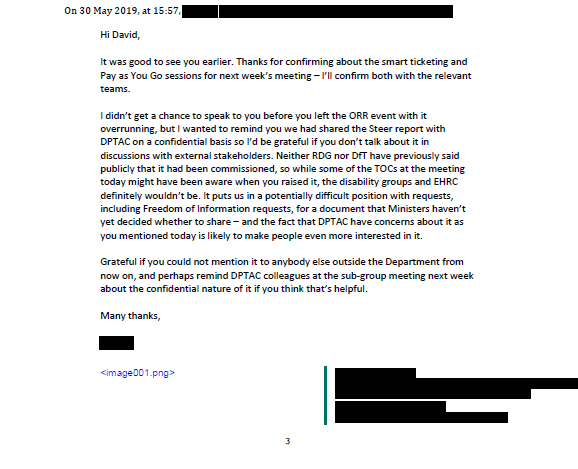
However, it’s clear in the correspondence that ministers are deciding whether to publish, not when. An email from May 30th, where a DFT civil servant chastises a member of DPTAC for referring to the report at an ORR event, states that: ‘Ministers haven’t yet decided whether to share’ and ‘whilesome of the TOCs at the meeting today might have been aware when you raised it, the disability groups and EHRC definitely wouldn’t be.’
The DPTAC email correspondence shows the 2018 Steer Report passing through at least three ‘iterations’, a process managed by the Rail Delivery Group in collaboration with consultants Steer – and in which they have sought feedback from train operating companies ‘to ensure recommendations are feasible’. The following excerpts from February 2018 further demonstrate this unhealthy dynamic:
From DPTAC meeting minutes – 12th Feb 2019:
Our requests to the Transport Select Committee:
(1) At his 8th May update to the Transport Select Committee, the Rail Minister Andrew Jones maintained that driver only operation is ‘not policy’. This is no more than an issue of semantics, relating to a behind-the-scenes legal wrangle over who holds the Public Sector Equality Duty in franchise contracts. The documents we’ve published today show that this legal discussion is already going on behind the scenes at the DfT, who are undoubtedly preparing for a legal challenge from the Equality and Human Rights Commission. We call on the Transport Select Committee to seek sight of any legal advice provided to the Department, which could potentially influence changes to legislation following the Williams Review and is therefore in urgent need of oversight.
The following paragraph from a DfT civil servant sent to a member of DPTAC on 30th December 2018.
(2)We call on the Transport Select Committee to demand all ‘iterations’ of Steer report(s) on driver only operation since 2013, and to question the Rail Delivery Group thoroughly on the report’s six year history. We will continue to request the 2018 Steer Report under FOI, but our primary concern is that documents are being withheld from the Transport Select Committee, meaning there can be no proper scrutiny of Departmental policy.
(3)We call on the Transport Select Committee to undertake an investigation into transparency and research standards at the DfT. Railway policy has been developed behind closed doors for up to a decade, and it is outrageous that this ‘research’ process appears to have been dominated by the Rail Delivery Group, the majority of whose members are train operating companies. Despite years of industrial conflict on the issue, the TSC has not even been allowed to view the business case for DOO (which we believe to be contained within the earlier 2013 Steer report).
Following our blog post last Thursday, the Office of Rail and Road (ORR) has confirmed GTR’s £5 million fine for its breach of licence relating to passenger information during last year’s May timetable crisis. As a result of our intervention, the final decision was announced on the day of the Williams Rail Review deadline (31st May).
It is the first time the ORR has imposed a fine for breach of licence, meaning that an important new precedent has been set for holding train operating companies to account. Their final penalty notice finds that GTR’s conduct around passenger information was “towards the negligent end of the spectrum” and says that the fine will provide a “transparent signal to the industry” about passenger information standards. After a full review of the documents we’ve discovered that the ORR went forward with this penalty despite submissions from GTR, the Department for Transport, and even Transport Focus, to accept a lower figure.
After reviewing their final penalty notice, we believe that the ORR has not only succeeded in imposing a precedent-setting fine, but has also chosen to “show its teeth” in an extremely difficult context; where the Department for Transport was already complicit in the failure of GTR’s management contract. Could this decision be a sign that the Office of Rail and Road is getting stronger and fighting for passenger rights while every other rail agency and passenger watchdog is still letting us down?
GTR’s £5 million fine: what went on behind the scenes?
The £5 million fine was announced on 14th March, and followed by a 21 day consultation period, during which the ORR had the power to ‘reduce the fine to zero’ or ‘increase it several fold’ (according to paragraph 139 of their penalties policy).
The ORR had categorised the breach of licence in the ‘moderately serious’ category, and their decision to choose a £5 million ‘starting point’ was also moderate in this context (the ‘moderately serious’ category of offence has a starting point of up to £10 million). During the 21 day consultation period that ran until 5th April, submissions could be made to the ORR in to have the amount reduced, or for the train operating company to make an offer of “reparations”.
GTR completely refused responsibility
GTR made no offer of reparations and maintained the position throughout the consultation that the £5 million penalty should not be imposed at all, and that if it were imposed, that it should be a lower amount. The ORR’s final penalty notice makes clear that GTR has not acknowedged reponsibility:
“there is a lack of evidence that GTR undertook a significant lessons learnt exercise relating to passenger information and have focused instead on the wider industry failings. GTR have not acknowledged responsibility for its failure to provide adequate information to passengers.” (paragraph 39)
The only other submission within the consultation period was made four days before the consultation deadline by Transport Focus, who encouraged the ORR to consider an offer of reparations, “assuming an offer is put forward”. As GTR had not made any offer of reparations, the ORR judged Transport Focus’ submissions to be ‘inapplicable’.
The Department for Transport supported Govia Thameslink Railway
The ORR’s final penalty notice also shows the Department for Transport advocating on GTR’s behalf. After news broke of GTR’s £15 million “fine” for the 2018 timetable collapse in December, the DfT wrote to the ORR suggesting they show restraint in imposing any penalty. They said in the letter that they had already “entered into an agreement” that GTR would “make an additional £15 million available” to “develop and implement initiatives” that would benefit GTR passengers.
After December’s letter, the ORR asked the DfT to further explain December’s £15 million “fine”. In a further letter on 20th February 2019, the DfT said the following.
“On the level of the fund I suspect all we could say is that we took all the facts and circumstances into account including the level of the previous payment made by GTR in relation to the 2016 problems on Southern, the desire to create a fund which could provide meaningful benefits for passengers and the financial position of the TOC: pointing out that with the fund set at this level GTR will make no profit at all this year in recognition of their role in the disruption.” (paragraph 59)
Considering the full history of the management contract between the DfT and GTR – especially the fact that the Department had already allowed GTR to buy out their liability for the timetable collapse – it is not clear whether this was in fact a “fine” or simply a “fund”, ie. just another “remedial measure” of the kind that the DfT has been making since 2016 to bolster the GTR contract – and with zero scrutiny.
What is the Passenger Benefit Fund?
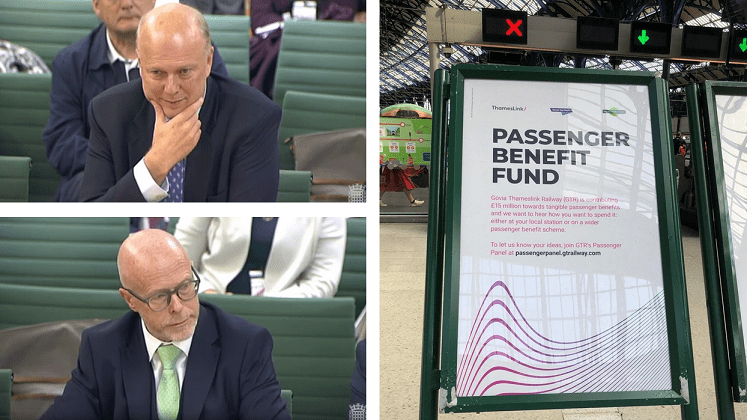
Here’s the part where it gets interesting in relation to ongoing passenger information issues. Many commuters have expressed outrage about the £15 million ‘Passenger Benefit Fund’ posters that they have started to see all over the GTR network; which state that “GTR is contributing £15 million in tangible passenger benefits” and completely erases the true history of the company’s failure, without even a hint of an apology. It is clear to us that the advertising materials are an attempt to derive PR value and ‘reputational capital’ from what is essentially a false political communication in a public space. Several of us have already reported this issue to the Advertising Standards Authority, and we encourage you to join us by submitting your own complaint.
And after reading the ORR’s final penalty notice last Friday, it seems the situation is even worse than we thought:
“As for the Passenger Benefits Fund, ORR notes that it has not been provided with a copy of the agreement between GTR and DfT pursuant to which the fund was set up or any clear explanation of its purpose and scope.” (paragraph 58)
“ORR have become aware of a new website that has been set up in recent weeks in relation to the Passenger Benefits Fund which sets out how the funding will be allocated to the stations affected and how passengers can propose local or wider passenger benefit schemes. Under “wider passenger benefit schemes”, the site suggests some examples of possible schemes that would lead to passenger information improvements.” (paragraph 62)
“ORR recognises that the operation of the fund could result in some improvement to the provision of passenger information at specific stations (e.g. an additional CIS screen,) but only if a significant proportion of passengers support such an improvement. Further,it is not sufficiently clear whether the fund will go towards making passenger information improvements for it to have any, or any significant, weight in the penalty assessment. Finally, it is in any event highly doubtful whether any such forward-looking information improvements as may be brought about by the fund would constitute “reparations” to those who were affected by the breach [of passenger information rules].” (paragraph 63)
Join us to make an unstoppable passenger watchdog:
Since the start of their disastrous management contract in 2015, no existing watchdog has been good enough to represent passengers’ interests on GTR, or ensure accountability. The ORR’s final penalty notice shows that the Department for Transport is, even now, advocating on GTR’s behalf, and proves that oversight is urgently required on the Passenger Benefit Fund.
As always, we have noone to rely on but ourselves – a grass roots network of passengers. If you’re as shocked as we are about the standards of dishonest communication on our railways, then please make a complaint to the Advertising Standards Authority and include a link to this blog post. Please also do all you can to alert press, local councillors and MPs, as very little of this story is reaching the mainstream media.
This International Women’s Day, it’s time to demand that the Department for Transport finally listens to passenger concerns about safety, security and access. We’ll be meeting at Great Minster House at midday on Friday 8th March to deliver an 85,000-strong petition to “Keep The Guard On The Train” and we hope that you can join us!
All are welcome, and we are particularly keen to celebrate the women who have done so much to defend against the government-driven attempt to remove guards from trains. Special guests will include; Beth Granter, who began the petition for women’s safety on the railways; Ann Bates OBE, who has campaigned alongside ABC for three years on disabled access; and Michelle Rodgers, the recently elected President of the RMT union and the first woman in its history to hold this position.
Sign up to our Facebook event here or RSVP to contact@abcommuters.com
Why International Women’s Day?
Over the past ten years, sexual offenses on the railways have gone up a staggering 167%, and violent crime has risen by 47%, according to recent figures from the British Transport Police (BTP). In the period 2017-2018, these categories of crime are up 16% and 26% respectively. In the case of sexual offenses, the BTP believes that there are many more crimes of this type that go unreported.
All vulnerable passengers deserve the peace of mind of knowing there will be a safety critical, guaranteed guard on every train, not to mention the deterrent factor in an era of rising crime. In rural areas, including Southern Rail, Northern Rail and South Western Railway, there are long gaps between stops and largely unstaffed stations – so the suggestion to destaff these networks should never have even been up for debate.
Despite this context – and a three-year long industrial dispute on the matter – passengers in England have never been consulted on the issue of driver only trains. During our campaign on the matter, we have dug up multiple documents emphasising concerns around safety and disabled access, but our concerns have been ignored. With the Equality and Human Rights Commission recently stating that they are likely to take action over the roll back of disabled access associated with DOO, we’ll be appealing directly to the DfT and the Williams Rail Review to return to the vision of a fully staffed railway, accessible to all.
Join us to demand a guaranteed and safety critical member of staff on every train – no excuses!
Today has been another shocking day for rail – a damning report from the Public Accounts Committee about the DfT, Keith William’s statement that franchising has failed and – most significantly of all – a £100 million class action launched this morning against several major train operating companies.
The legal claims have been launched with the Competition Appeal Tribunal against the following rail operators:
The £100 million claim relates to train companies overcharging millions of passengers because of the issue of “boundary fares” where they purchased tickets for travel beyond the zones covered by their Travelcards. The claim argues that they should have been offered the chance to pay “boundary fares” for the “gap” between the outer limit of their zone coverage and their destination. However, passengers have ended up paying twice because these fares were not promoted, made available online, at ticket machines and rarely offered at ticket counters. You can read more in today’s Evening Standard.
We believe this case will send a shock wave throughout the entire rail industry, and may even open the floodgates for more of these claims – after all, it is not just South Western and South Eastern passengers that suffer from the “boundary fare” issue around London.
The rail industry and the government have been aware of this problem for a very long time – but have made no serious attempt to fix it. The exact issues constituting the legal claim today were discussed in the press by our spokesperson Martin Abrams as long ago as September 2015. Click here to read what he had to say at the time.
We must take action: Transparency Now!
Representatives from ABC have a meeting with Keith Williams on Monday 18th March and will report to him all the transparency, justice and consumer rights issues we’ve encountered – especially on Govia Thameslink Railway.
Please write to us at contact@abcommuters with the subject line “Transparency Now” if you would like to submit your opinions, experiences, facts or new evidence to our submission to Keith Williams.
We are pleased to report that last Friday’s event at the Department for Transport was a great success. The Williams Review team have now confirmed that they WILL indeed be considering public ownership, and WILL take submissions from the public up until the end of May (not 18th January as previously advertised.) We also had the chance to speak with a representative from the Williams Rail Review team and made the point that we want this review to be transparent and democratic from the start.
We Own It co-organised the event – read more at weownit.org.uk
Comment from the Rail Review team
“The government’s vision is for the UK to have a world-class railway, working as part of the wider transport network and delivering new opportunities across the nation. The Williams Rail Review, led by independent Chair Keith Williams, was established to recommend the most appropriate organisational and commercial frameworks to deliver this. The Review is deliberately comprehensive in scope and Keith Williams has been asked to be bold in his thinking, challenging received wisdom and looking to innovate. The Review is considering all parts of the industry, from the current franchising system and structures, to further devolution, accountability and value for money. Keith is supported by an independent challenge panel, with expertise in business, customer service, and the rail and broader transport sector. The Review will conclude with a Government White Paper at the end of 2019 and we expect reform to begin from 2020 so passengers benefit, as soon as possible.
The Review is exploring the full spectrum of reform options in every case. Keith Williams and the team have been and continue to conduct an extensive listening exercise across the entire rail industry and those that use it. This includes a number of visits across Great Britain to better understand the differing experiences of the current railway and the commissioning of new, objective research into the thoughts and needs of rail passengers. As part of this listening exercise, Keith Williams is happy to meet ABC and the Review team can arrange this.
The Review’s Call for Evidence is a vital part of Keith William’s information gathering and listening to those with experience of the railway. The Call for Evidence will remain open for much of the Review but may seek different levels of input as its work develops. Currently it has requested a broad input to match its terms and ensure it captures all views from the start. As Keith Williams develops his ideas, further input will be requested against more specific questions.
Keith Williams and the Review team can be sent information through the call for evidence or alternatively their dedicated mailbox: Rail.Review@dft.gov.uk.
Further details on the remit of the Williams Rail Review can be found on our terms of reference and we would very much welcome any evidence you may have, which can be submitted through the call for evidence for consideration.”
For the background to our investigation into the Williams Review click here, then here.
Our Next Steps
We have accepted Keith Williams’ offer of a meeting and hope to speak with him in March, at around the time he will be feeding back the first findings of his review. In the meantime, we will be writing up our own submission on the transparency and democracy issues we have encountered through multiple investigations into GTR and one major court case against the DfT. If you would like to contribute your thoughts on these topics, please write to contact@abcommuters.com.
If you would like to submit your thoughts on the need for public ownership, you can contribute to We Own It’s campaign on the Williams Rail Review, here.
To respond to the Williams Rail Review, click here.


 DPTAC recommends a ‘paradigm shift’ in which accessibility becomes a ‘fundamental’ part of the industry, rather then just an ‘add on’. Their May submission to the Williams Review includes a damning analysis of rail industry culture and structure; and calls for a ‘whole system’ approach that embeds accessibility ‘into the heart of what the rail industry does’. DPTAC also argues that rail vehicle accessibility legislation (TSI/RVAR) has provided a ‘relatively strong baseline’, and that there is now a strong case for new regulation with compliance deadlines for station accessibility. This would form part of a long-term funding strategy that could see the timeline to ‘full accessibility’ reduce from 100 to 40 years.



 The DPTAC email correspondence shows the 2018 Steer Report passing through at least three ‘iterations’, a process managed by the Rail Delivery Group in collaboration with consultants Steer – and in which they have sought feedback from train operating companies ‘to ensure recommendations are feasible’. The following excerpts from February 2018 further demonstrate this unhealthy dynamic: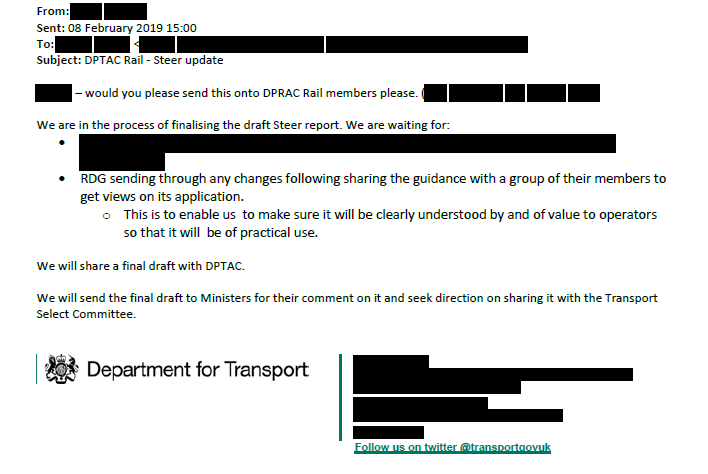



 abcommuters.com