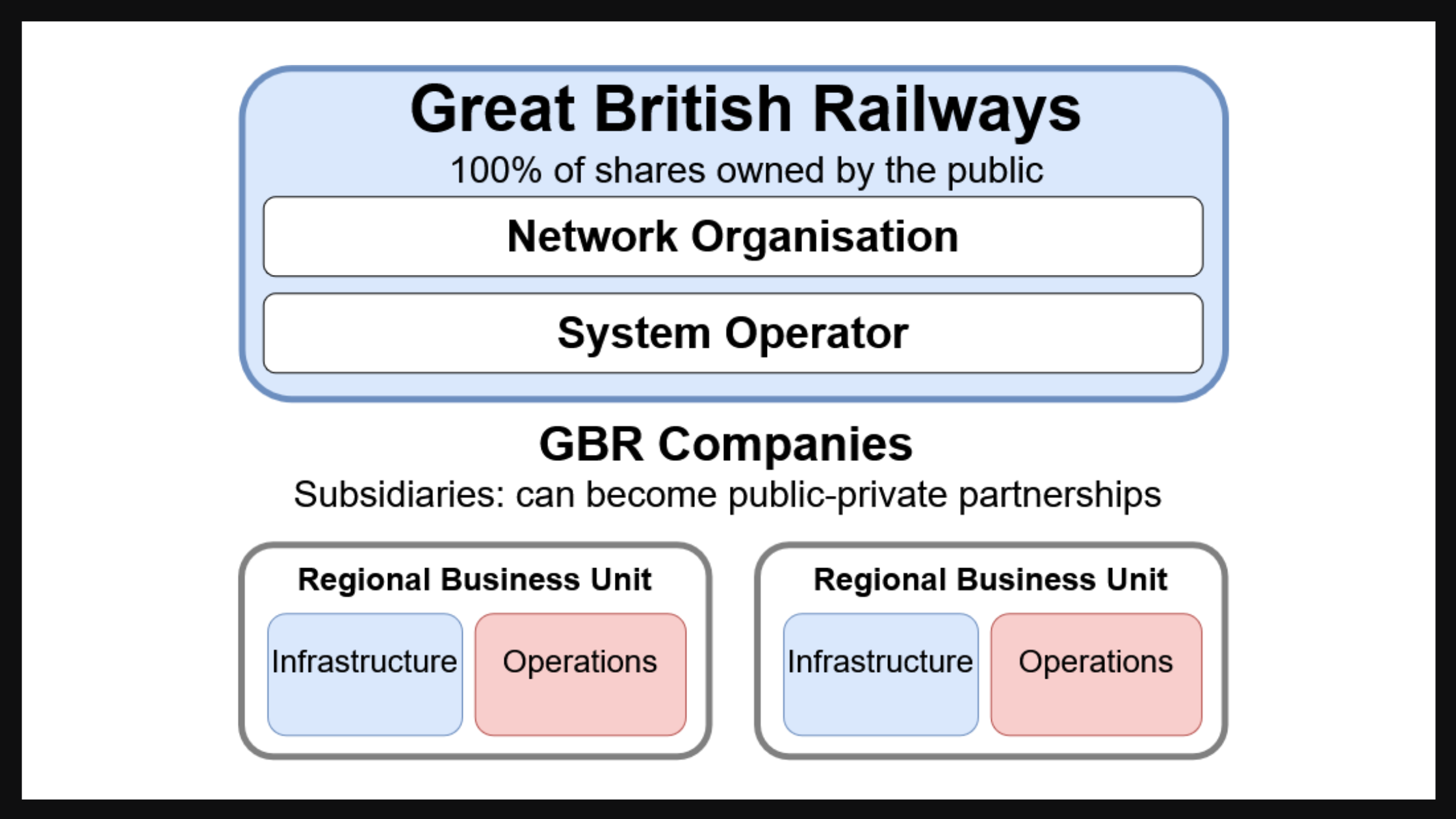
The Railways Bill is supposed to be a tool for bringing the railway fully into public ownership and integrating its structure and finances. However, there is great uncertainty on both these counts, with no clear plan for organisational design and multiple loopholes for re-privatisation.
The public and politicians must be informed that the Railways Bill will:
- Repeal the Passenger Railway Services (Public Ownership) Act 2024 almost entirely, allowing any GBR company to become a public-private partnership.
- Fail to create ‘vertical integration’ in GBR’s structure, despite this being the main purpose of GBR since 2021, agreed by successive governments and expert consensus to be the only solution for a densely used rail network like Britain’s.
- Fail to integrate the financial framework of GBR, causing a fundamental split between budgets, due to strict subsidy control rules that will now dictate GBR’s design, restrict policymaking and threaten the value of public money.
Download the full briefing here, or read on for a summary version below.
Ownership
A government amendment to the Bill at the Commons Report Stage secured that Great British Railways must be ‘wholly owned’ by the public.[1] However, this protection only applies to its parent company and has obscured the fact that the Railways Bill will repeal the Passenger Railway Services (Public Ownership) Act 2024 almost entirely,[2] changing key definitions to allow public-private partnerships and creating loopholes for a potential return to private contracting. This includes:
- Defining GBR companies as ‘subsidiaries’ within the meaning of section 1159 of the Companies Act 2006.[3] This means that any GBR function, including train operations and infrastructure managers,[4] can become a public-private partnership, with the only requirement that GBR keeps a controlling stake. This overturns the definition of the 2024 Act, which required a public sector company to be ‘wholly’ publicly owned.[5] The alternative term ‘wholly owned subsidiary’ was easily available under section 1159 of the Companies Act 2006, so this was clearly a deliberate choice.
- Creating loopholes that could permit a return to private rail operations; including franchising and concessions. For example, Clauses 25(1) and 31(1)-(2) require that the Secretary of State ‘must designate railway passenger services, or a description of railway passenger services’ but only that they ‘may’ secure the provision of those services. Only when the Secretary of State both designates and secures services is there a requirement to do so by ‘making a direct award of a public service contract…to one or more of Great British Railways or a GBR company.’ There is no provision governing how services would otherwise be secured, which gives flexibility for national passenger services to be awarded to private operators by another party (such as GBR or a GBR company). The omission removes the safeguard in the 2024 Act that designated services could be secured only from a public-sector company, regardless of the franchising authority.[6]
Structure
Since the first White Paper in 2021, successive governments have recognised that fragmentation is the primary cause of failure in Britain’s railway.[7] The purpose of GBR has therefore been to create the ‘vertical integration’ of infrastructure, operations and timetabling – agreed by expert consensus to be the best possible structure for a densely used network like Great Britain.[8] The wastefulness of fragmentation led the Conservative government to estimate in 2021 that this could lead to £1.5 billion savings per year, from the benefits of integration alone.[9]
However, the current government has been unable to make any estimate of the costs and benefits of GBR, concluding in their impact assessment of the Railways Bill that:
“[T]here are significant gaps in the evidence base and high uncertainty around the long-term impacts of these reforms… the long-term impacts on outcomes such as finances and performance will depend on decisions on GBR design which have not yet been made.”[10]
What we know for certain is that, in its current form, the Railways Bill will prevent the integration of budgets and accounts between infrastructure and operations. This is despite the fact that it is recognised by experts to be crucial to gaining the full financial benefits of vertical integration; [11] has been a key objective for GBR from the start; and strongly supported by the rail industry, with the Rail Industry Association warning the government in 2025 that ‘If track and train integration is to be achieved, then both must be covered as part of the same [funding] process.’[12]
The reason that this cannot be done is the government’s approach to the Subsidy Control Act 2022, which is the overarching legal framework of the Bill. This is the direct cause of the split between infrastructure and operations budgets, with the purpose of monitoring the use of subsidy, and preventing cross-subsidy or the redirection of commercial subsidy, because this may help GBR gain a commercial advantage above competitors.[13] It will now dictate every future decision on GBR’s organisational design…
To read more, download the full Briefing on GBR Ownership and Structure here.

[1] Railways Bill, Clause 1
[2] Railways Bill, Schedule 4, para 11 which omits from the Railways Act 1993 sections 23 to 31, including the sections inserted by the 2024 Act.
[3] Companies Act 2006 section 1159:
‘(1)A company is a “subsidiary” of another company, its “holding company”, if that other company—(a) holds a majority of the voting rights in it, or (b) is a member of it and has the right to appoint or remove a majority of its board of directors, or (c) is a member of it and controls alone, pursuant to an agreement with other members, a majority of voting rights in it, or if it is a subsidiary of a company that is itself a subsidiary of that other company.’
[4] Railways Bill, Clause 3(5)
[5] Passenger Railway Services (Public Ownership) Act 2024, section 2(3), inserting section 30C into the Railways Act 1993
[6] Passenger Railway Services (Public Ownership) Act 2024, sec 2(2), inserting section 30(1A) into the Railways Act 1993
[7] Conservative and Labour governments have recognised the main cause of failure to be fragmentation, including Information and Coordination Failure; Principal-agent issues; Failure to take account of Externalities; and Productive Inefficiency. DfT, Railways Bill Impact Assessment (2025), p5-10; Williams-Shapps Plan for Rail Impact Assessment (2022), p 8-9
[8] DfT, Railways Bill Cost Impact Assessment (2025), 99-103
[9] DfT, Williams-Shapps Review (2021) p 8, 36. The McNulty report on rail value for money (2011) estimated £1 billion per year savings from integration.
[10] Ibid, 129
[11] Ibid 100
[12] Railway Industry Association, Response to GBR Consultation (2025), p 3-4.
[13] Subsidy Control Act 2022, sec 2
Leave a Reply